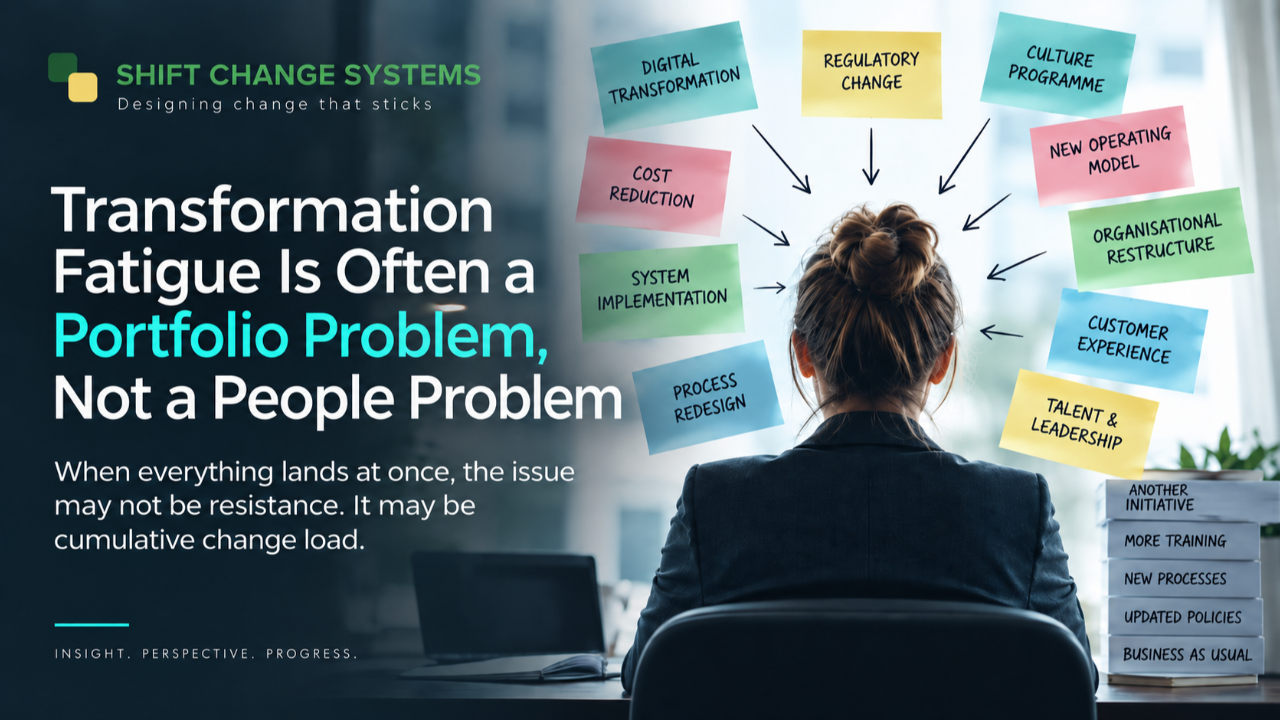
Transformation Fatigue Is Often a Portfolio Problem, Not a People Problem
Sep 18, 2026Organisations undergoing significant transformation often talk about “change fatigue” as though it were primarily an employee issue. When engagement falls, enthusiasm weakens or people begin to question yet another initiative, the explanation is frequently that employees are tired of change. That can be true, but it can also be too simplistic. In many cases, the deeper problem is not that people are inherently resistant to change, but that the organisation has created an environment in which too many initiatives are landing on the same people, at the same time, without enough consideration of sequencing, capacity, leadership attention or operational reality.
This matters because the language we use shapes the solution we reach for. If leaders believe the problem is fatigue, they may respond with more communication, more engagement activity or another round of wellbeing support. Those interventions may help at the margins, but they do not resolve the underlying issue if the organisation is simply asking too much of the same teams. What looks like resistance may actually be overload, conflicting priorities or a lack of clarity about what matters most.
One of the persistent weaknesses in transformation is that organisations still tend to manage change programme by programme. Each initiative has its own business case, governance, milestones, sponsor and reporting structure, and viewed in isolation each one may appear perfectly manageable. The difficulty is that employees do not experience transformation in that way. They experience the combined effect of everything happening around them, including system implementations, restructures, process redesigns, new performance expectations, policy changes, training requirements and ongoing business as usual pressures.
A manager can therefore be told that five different initiatives are all strategically important while still being expected to maintain service performance, support their team, attend programme meetings, complete mandatory activity and absorb new ways of working. From the perspective of each project, the asks may look reasonable. From the perspective of the manager receiving them, the cumulative demand may be unsustainable.
This is where the idea of organisational capacity needs to become more sophisticated. Capacity is often discussed as a resourcing issue, but it is also cognitive, behavioural and leadership-related. People can technically have time in their diary while having very little mental capacity left to absorb another major change. Managers can attend a briefing without being in a position to lead their teams through another transition. Employees can complete another training course while still trying to stabilise a previous process change.
When this broader view of capacity is missing, organisations tend to continue adding work until the pressure becomes visible through disengagement, declining performance, increased errors or more overt resistance. By that point, the problem is often described as a people issue, even though it was created by portfolio decisions.
That is why Change leadership needs to operate at a level above individual projects. A mature Change function should be able to see where different initiatives are landing, which populations are being repeatedly impacted, where implementation dates are clustering and where leadership attention is being stretched too thinly. It should also be able to identify where benefits from one programme are at risk because another initiative is arriving before the first has had time to embed.
This portfolio view becomes particularly important in organisations that are trying to transform at pace. Speed can create energy and momentum, but it can also create congestion. If several strategically important programmes depend on the same teams, the same managers or the same operational capacity, then sequencing becomes a leadership decision rather than a project scheduling exercise.
The challenge is that prioritisation is often easier to talk about than to practise. Organisations frequently declare that certain programmes are priorities without being willing to deprioritise anything else. In that environment, everything remains important, nothing is genuinely sequenced and operational teams are left to reconcile the conflict themselves.
A mature Change function should be able to challenge this. That does not mean saying no to every additional request, but it does mean asking whether the organisation is capable of absorbing the proposed level of change and whether all initiatives require the same degree of support. Some changes may need intensive Change intervention, others may only need targeted support, and some may need to be delayed because the organisation is already operating beyond a sustainable level of change load.
This is also one of the areas where AI can be useful, provided it is applied with judgement. Organisations often hold relevant information across project plans, stakeholder maps, impact assessments, training data, survey results and operational metrics, but they rarely bring those signals together in a meaningful way. AI can help identify patterns across those sources, highlight populations affected by multiple initiatives and surface areas where several changes are converging at once.
That creates a real opportunity to move from retrospective conversations about fatigue towards earlier decisions about sequencing and organisational readiness. However, AI does not remove the need for leadership judgement. It may show that one part of the organisation is carrying an unusually high level of transformation activity, but it cannot decide which programme should move, which deadline should change or which strategic ambition should be moderated.
Those decisions remain difficult because most transformation activity is individually justifiable. Digital improvement matters, cost reduction matters, customer experience matters, regulatory change matters and operating model improvement matters. The challenge is that they may all depend on the same finite organisational capacity.
This is why transformation leadership requires discipline as well as ambition. Sometimes the most responsible decision is to slow one initiative in order to allow another to succeed. Sometimes it is to reduce scope, create a stabilisation period or delay implementation until the organisation is genuinely ready. Those choices can look less exciting than launching something new, but they often protect more value in the long term.
There is also a cultural issue here. Organisations often praise resilience while underestimating how often resilience is being used to compensate for weak prioritisation. Teams can absorb a great deal for a period of time, but if overload becomes the operating norm, then resilience can become a euphemism for asking people to carry structural problems indefinitely.
This is why the language of “change fatigue” deserves more scrutiny. It can unintentionally shift accountability away from the organisation and towards the people experiencing the consequences of its decisions. Instead of asking why employees are tired, leaders should ask whether the portfolio has been designed in a way that gives people a realistic chance of succeeding.
That does not mean every difficult reaction to transformation is justified or that resistance should be ignored. People will sometimes oppose change because they disagree with it, because they prefer the status quo or because they do not yet see the value. Those are legitimate Change Management challenges. The problem is that resistance, overload, ambiguity and poor sequencing are not the same thing, and treating them as though they are can lead to the wrong intervention.
The stronger question for leaders is therefore not simply whether employees are ready for the next programme. It is whether the organisation itself has created the conditions in which readiness is possible.
For me, that is one of the most important shifts in how Change functions need to evolve. The future of Change Management is not only about helping people through individual initiatives. It is also about helping organisations understand the cumulative effect of transformation and make better decisions about pace, sequencing, capacity and value.
Because sometimes people are not tired of change.
They are tired of being asked to absorb too much of it, without enough organisational discipline around what should happen first.
