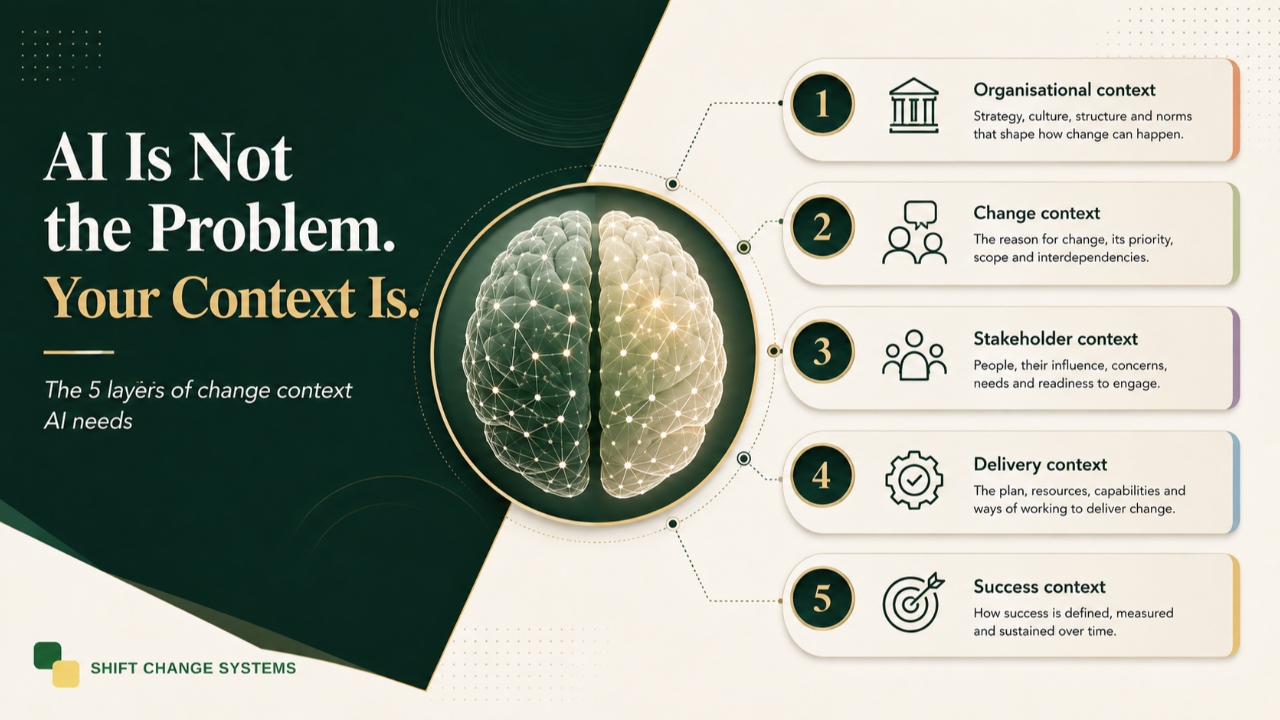
AI Is Not the Problem. Your Context Is.
Aug 02, 2026Why Change Managers receive polished but generic outputs, and what stronger strategic briefing looks like in practice
Generative AI has made it possible to produce stakeholder plans, communication strategies, readiness assessments and impact analyses in a matter of seconds. The speed is impressive, but speed can create a false sense of quality. Many outputs look complete because they are well structured, professionally written and logically organised. Yet when a Change Manager attempts to use them in practice, something is often missing.
The stakeholder plan could belong to almost any organisation. The readiness assessment relies on familiar terminology without revealing anything specific. The communications recommendations appear sensible, but do not account for operational pressures, stakeholder history or the realities of implementation.
This is the point at which many professionals conclude that AI is not yet capable of supporting complex change work. Others assume the problem sits with the wording of the prompt and begin searching for a more sophisticated formula.
Sometimes the prompt does need improvement. However, in my experience, the deeper issue is usually that the AI has not been given enough meaningful organisational context to produce a credible answer.
The problem is not always the quality of the technology. It is often the quality of the briefing.
Change Management is inherently contextual
Change Management cannot be applied as a standard process without regard for the environment in which change is taking place. Two organisations may be introducing the same technology, redesigning the same service or moving towards a similar operating model, yet require very different approaches.
One organisation may have strong leadership sponsorship but low levels of trust among operational teams. Another may have a supportive workforce but weak governance and unclear accountability. One may be recovering from a previous transformation that failed to deliver its intended benefits. Another may be attempting to implement several overlapping changes while employees are already operating under considerable pressure.
The technical solution may be similar, but the organisational conditions are not.
This is something I have observed repeatedly while designing operating models, building change ecosystems and leading operational, digital and organisational change. The most difficult part is rarely defining what should happen in theory. The more demanding task is understanding what the organisation can absorb, how decisions are genuinely made, where accountability sits, which behaviours are reinforced and how previous experiences have shaped current levels of confidence.
That context changes the interpretation of almost every issue.
A stakeholder described as resistant may be responding rationally to a history of poorly implemented change. A leader who appears disengaged may be managing conflicting priorities and unclear decision rights. A team assessed as unready may not lack commitment, but may lack the capacity, authority or support required to adopt a new way of working.
Without this level of understanding, AI can generate recommendations that are logically plausible but strategically weak.
Polished output can disguise incomplete thinking
One of the most significant risks associated with generative AI is its ability to make incomplete analysis appear complete.
An output may contain the expected headings, recognised frameworks and professional language. It may appear confident and coherent. However, confidence of tone is not evidence of organisational insight.
This distinction matters in change work because weak assumptions can influence real decisions. A generic stakeholder strategy may result in the wrong groups being engaged at the wrong time. A superficial impact assessment may overlook changes to workload, authority, process or local behaviour. A readiness plan based on optimism rather than evidence may give leaders false confidence before implementation.
The output may look finished, while the thinking behind it remains underdeveloped.
Change professionals therefore need to evaluate AI generated analysis with the same discipline they would apply to any other source of advice. They need to ask what evidence supports the conclusion, which assumptions have been made, whose perspective is missing and what organisational factors may make the recommendation difficult to implement.
The quality of the formatting should never distract from the quality of the reasoning.
Prompting is not the same as briefing
Much of the current advice on using generative AI focuses on prompt construction. Professionals are encouraged to assign the AI a role, define the format, specify the tone and request a particular type of output.
These techniques are useful. They improve clarity and help shape the response. However, they do not replace a meaningful brief.
Prompting tells the technology how to respond. Briefing gives it something substantive to work with.
A Change Manager would not ask an external consultant to create an adoption strategy after providing only the instruction, “Develop a stakeholder plan for a new system.” The consultant would need to understand the organisation, the case for change, the groups affected, the implementation constraints, the history of previous initiatives and the outcomes expected.
The consultant would also be expected to ask questions before presenting a recommendation.
AI should be approached with the same level of discipline.
The strongest input is not necessarily the most elaborate prompt. It is the clearest strategic brief.
The five layers of context
In practice, useful AI supported change analysis depends on five connected layers of context.
Organisational context
The first layer concerns the environment in which the change is taking place.
This includes the organisation’s purpose, structure, culture, operating environment, regulatory obligations, current pressures and decision making style. It may also include the extent to which authority is centralised or distributed, the maturity of existing systems and the organisation’s appetite for change.
A recommendation that is suitable for a highly centralised organisation may not work in an environment where local leaders have significant autonomy. An approach that is appropriate for a high growth business may be unrealistic in a highly regulated service setting.
Organisational context establishes the conditions within which the change must operate.
Change context
The second layer concerns the change itself.
AI needs to understand what is changing, why the change is required, which problems it is intended to address and what will be different in practice. It also needs clarity on scope, timing, dependencies and the decisions that have already been made.
Where the brief is vague, the AI will fill the gaps with general assumptions. The response may still sound convincing, but it will be detached from the initiative.
The more ambiguity contained in the input, the greater the risk that the output will be generic.
Stakeholder context
Stakeholder context requires more than a list of roles and influence scores.
AI needs information about how different groups will be affected, what they may gain or lose, their previous experience of change, their current workload, the strength of local leadership and the degree of trust they place in the organisation.
This is where professional and lived organisational knowledge becomes particularly important.
A stakeholder map can appear comprehensive while still missing the informal relationships, local histories and behavioural dynamics that determine whether a change will succeed.
Delivery context
Change activity does not take place separately from project delivery.
The AI needs to understand implementation timelines, resource constraints, solution maturity, governance arrangements and operational dependencies. It also needs to understand where delivery decisions may create consequences for readiness, adoption and benefits realisation.
A project can appear technically ready while the business remains unprepared. Equally, a Change Manager can design a strong engagement approach that becomes ineffective because key delivery decisions remain unresolved.
Delivery context connects the change approach to what is actually possible.
Success context
The final layer concerns the meaning of success.
Success may involve launching on time, achieving consistent use of a new process, reducing workarounds, improving service quality, increasing capability, realising financial benefits or sustaining new behaviours over time.
Without a clear definition of success, AI will often default to activity. It may recommend more communication, more engagement, more training and more meetings.
However, activity is not the same as adoption, and adoption is not always the same as value.
Success context helps move the analysis from a list of actions towards a clearer understanding of the outcomes the organisation is trying to achieve.
More information is not always better
Providing context does not mean uploading every available document or sharing large volumes of unfiltered information.
The objective is not volume. It is relevance.
A strong strategic brief should help the AI understand the environment, the specific change, the people affected, the delivery constraints, the evidence available and the outcomes that matter.
This requires judgement.
The Change Manager must decide what is material, what is sensitive, what may be unreliable and what should not be entered into an AI tool at all. They must distinguish between useful organisational evidence and background information that adds little value.
This process of selection and interpretation is part of the professional contribution. It cannot simply be outsourced to the technology.
Professional judgement remains central
AI can identify patterns, organise information, compare perspectives and generate useful questions. It can help a Change Manager challenge assumptions and examine risks that may not have been considered.
What it cannot do is fully interpret the social reality of an organisation.
It cannot determine whether a senior sponsor is publicly supportive but privately unconvinced. It cannot know whether a communication will be trusted by a workforce that has heard similar assurances before. It cannot confirm whether a formally agreed decision will be followed in practice.
These judgements depend on observation, relationships, experience and organisational awareness.
As both a practitioner and a lecturer, I am increasingly interested in the distinction between technical capability and professional capability. Knowing how to operate an AI tool is not the same as knowing how to use it responsibly within complex organisational work.
The technology may produce the output, but the Change Manager remains responsible for interpreting it, challenging it and deciding whether it is appropriate.
The future of AI in Change Management is therefore not about replacing expertise with prompts. It is about combining technological capability with stronger professional judgement.
A more disciplined way to use AI
When AI produces a generic response, the instinct is often to rewrite the instruction. A more useful approach is to improve the context before changing the wording.
Take one existing change task and brief it properly.
Explain the organisation in which the change is taking place. Describe the initiative and the problem it is intended to address. Clarify who will be affected, what has happened previously and which delivery constraints must be considered. Define what success means.
Then ask the AI to identify what information is still missing before it produces a recommendation.
That final step is particularly important.
A strong Change Manager does not simply ask for an answer. They test whether there is enough evidence to answer the question well.
This is the distinction between using AI to produce content and using it to support professional thinking.
The organisations that gain the greatest value from AI will not necessarily be those that generate the most material. They will be those whose people know how to provide stronger context, ask better questions and apply disciplined judgement to the response.
AI is not necessarily giving Change Managers bad answers.
Too often, we are asking it to work without the organisational understanding that credible change decisions require.
No amount of polished prompting can compensate for a weak brief.
